
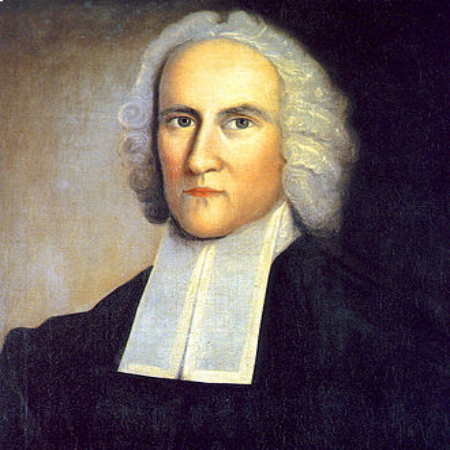
Edwards was born in East Windsor, Connecticut, the son of Timothy Edwards and grandson of the famed Solomon Stoddard. From birth he was set aside for the ministry, and at an early age he resolved to be great in the cause of Christianity. Following his education at Yale College, Edwards served briefly at pastorates in New York City and Bolton, Connecticut, and then moved to Northampton, Massachusetts, where he served with his grandfather and, upon Stoddard’s death in 1729, as senior pastor of the First Congregational Church. In his years at Northampton Edwards began producing the philosophical and theological works that would make him early America’s most eminent Christian philosopher. His intellectual leadership during the Great Awakening of the 1740s succeeded in rearticulating historic Calvinist theology within the categories of the “New Learning” championed by John Locke and Isaac Newton.
Following his dismissal from the Northampton congregation in 1750 over the issue of Communion and church membership, Edwards accepted a call to a Native American mission in Stockbridge, Massachusetts, where he remained until 1758. During these years, he completed many of his famous theological treatises including Freedom of the Will (1754) and Original Sin (1758). Edwards’s prodigious scholarship, however, did not come at the expense of his missionary activity with the Mohawk Indians. As evangelist and Native American school reformer, he worked tirelessly to meet the religious and educational needs of Native Americans and, by his example as much as by his words, established the foundation for Calvinist (“Edwardsian”) missions in the nineteenth and twentieth century.
In 1758 Edwards reluctantly accepted an appointment as president of the College of New Jersey (later Princeton College). He died of a smallpox inoculation, however, before serving his new appointment.
As minister, theologian, and missionary, Edwards has exercised profound influence not only on the thought, culture, and literary life of his own time but on American society to the present. He is a window into a critical period in American history and was a shaper of spiritual life in America. When historians seek a person who represents the Puritan, intellectual strain in the American character, they turn almost universally to Edwards.